

Speed Queen Certified — Park Ridge & Des Plaines
Speed Queen Repair Near Me in Park Ridge & Des Plaines, Cook County, IL
Local Speed Queen appliance repair near you in Park Ridge & Des Plaines — certified neighborhood technicians, genuine OEM parts, same-day availability across Cook County.
Mon–Sat 7am–8pm · Sun 9am–5pm
Schedule Your Repair
Service Type
What type of service do you need?
Or call us directly:
(312) 906-7315Speed Queen Appliances We Repair in Park Ridge & Des Plaines
Speed Queen engineering and service implications
Founded in United States and building appliances since 1908, Speed Queen competes in the commercial-domestic segment — but the useful fact for anyone holding a broken one is architectural, not historical. Commercial-grade laundry sold domestically, mechanical controls, heavy chassis is the design commitment the rest of the machine is arranged around, and it dictates what wears, what fails first, and what a competent diagnosis looks for before anything is unbolted. Across Cook County that matters commercially too: the gap between long-held bungalow appliances and near-new condo installs is unusually wide, so two machines of the same model year arrive in very different condition.
The single most useful thing to know about servicing Speed Queen is this: Speed Queen machines are built for 25-year lives, so repairing one at 15 years is normal rather than marginal. Technicians who work across every brand without accounting for it will reach the wrong conclusion on Speed Queen equipment more often than the fault rate justifies, and the customer pays for that in unnecessary parts. It matters more here than it would elsewhere, because parts move through Chicago-area distribution with same-day will-call on common stock — a wrong part is not just wasted money but a second appointment.
The practical upshot is that a Speed Queen fault and an outwardly identical fault on another badge frequently have different causes. Because the line is built around commercial-grade laundry sold domestically, mechanical controls, heavy chassis, the component under load when a symptom appears is not the one a generic troubleshooting tree would point at, and following that tree wastes a visit — expensive in Cook County, where freight-elevator windows and reserved loading docks decide when a high-rise job can actually happen, and a missed window costs a day rather than an hour.
Speed Queen and the Chicago operating environment
Speed Queen equipment does not meet Chicago on neutral ground. The governing local factor is brutal winters and wide seasonal temperature swings, with unheated garages and basement laundry rooms swinging across a 100°F annual range, and it is present whether or not the machine was specified for it. Because Speed Queen guidance is written against average conditions rather than these, domestic units here age on a different curve than the documentation assumes.
Where a Speed Queen lives counts for as much as the weather it lives in. Cook County is a mix of pre-war brick two-flats and bungalows alongside high-rise condo stock, where freight-elevator scheduling and tight galley kitchens shape every visit — the operating environment for every Speed Queen in the region. That intersects squarely with very few: the installation decides the speed at which the problem arrives, and whether an in-place repair is even possible once it does.
Water is the third variable. Chicago runs Lake Michigan supply in the city and mineral-heavy well sources across parts of the suburbs, which reaches Speed Queen inlet valves, spray arms and any water-fed component untreated by the appliance itself. The freeze–thaw cycle stresses water lines and ice makers hardest between December and March, and high-rise pressure swings add a second variable the suburbs do not have. Speed Queen equipment feels it on the same calendar.
Common Speed Queen failure points we see
Across Speed Queen equipment in Chicago, the recurring failures concentrate around very few; drive belts and lid switches over long service lives. That is a Speed Queen pattern rather than a general appliance pattern, and recognising it before opening the machine is most of the diagnostic work.
We service Speed Queen washer, dryer and the rest of the line. Each appliance type fails differently even within one brand, so the Speed Queen refrigerator diagnostic path and the Speed Queen laundry diagnostic path share very little beyond the parts channel. Across Cook County the mix skews by housing type as much as by brand, since the gap between long-held bungalow appliances and near-new condo installs is unusually wide, so two machines of the same model year arrive in very different condition.
Where Speed Queen equipment faults intermittently, the installation is the first thing we rule out and the control board is close to the last. On commercial-domestic machines that sequencing is worth real money to the customer, because the two ends of that list differ in cost by an order of magnitude — and in Cook County the expensive end also carries a wait, since parts move through Chicago-area distribution with same-day will-call on common stock.
On top of the brand pattern sits the local one. With brutal winters and wide seasonal temperature swings as the dominant stressor, exposed Speed Queen components run ahead of their design ageing curve — the failure that shows up at year eight in a gentler market can arrive at year five in Chicago.
Continuous duty and why domestic assumptions do not transfer
Commercial equipment is engineered for a completely different duty cycle: hundreds of cycles a day, continuous refrigeration, and operation in hot, humid, high-traffic environments. Applying domestic diagnostic assumptions to it produces wrong answers, and applying domestic service intervals to it produces failures.
The dominant failure driver is duty rather than age. Door gaskets, condenser coils, pumps and fan motors all wear on a schedule set by how hard the equipment works, which means a two-year-old commercial machine in a busy kitchen can need more attention than a ten-year-old domestic one. Preventive scheduling is not optional at this level; it is the difference between planned maintenance and a closed kitchen.
Downtime economics change everything about how these jobs are prioritised. A failed reach-in or ice machine costs a business revenue every hour it is out, so we carry the common commercial failure parts, work around service hours where we can, and are explicit about what can be got running today versus what needs a scheduled return.
Health-code and gas-safety requirements also apply to commercial installations in ways they do not domestically, and work has to be done and documented accordingly.
Sourcing Speed Queen parts in Chicago
The parts channel decides more Speed Queen repairs than most owners expect: excellent long-term support. Confirming availability is therefore part of the diagnosis, not an afterthought — a correct fault call you cannot act on for three weeks is not a useful answer, particularly on commercial-domestic equipment. Here that means working with the fact that parts move through Chicago-area distribution with same-day will-call on common stock, and checking stock at model-number level before we quote.
Repairs carry 90 days on parts and 30 days on labour, the same across every brand and every ZIP we cover in Cook County. Where Speed Queen equipment is still inside manufacturer warranty we tell you that and point you to the warranty route even though it means we do not do the job — a repair that voids your coverage is not a service.
When a Speed Queen part is truly out of production we tell you plainly and set the repair cost against a new machine, instead of fitting an approximate substitute that buys six months and a second fault. How often that comes up varies by brand; for Speed Queen the binding constraint tends to be availability rather than cost. It is worth adding that in Cook County, the gap between long-held bungalow appliances and near-new condo installs is unusually wide, so two machines of the same model year arrive in very different condition.
We cover Speed Queen service across Lakeview, Evanston, Oak Park and Schaumburg and the rest of Cook County, with same-day availability on morning bookings and no distance surcharge inside the county.
Keeping a Speed Queen running longer in Chicago
The things that shorten Speed Queen service life in Chicago are, with few exceptions, preventable — and largely absent from the manual, because the manual assumes average conditions rather than brutal winters and wide seasonal temperature swings. Clear condenser and heat-exchange surfaces are worth more than every other maintenance item combined on this brand: once airflow is restricted the compressor or element never gets to rest, and that sustained load is what takes years off the machine.
Water is the second factor. Because Lake Michigan supply in the city and mineral-heavy well sources across parts of the suburbs arrives at every wetted Speed Queen part with no conditioning, inlet screens, spray arms and fill valves scale up slowly instead of failing outright. The early symptom is not a fault at all but a slow decline — longer cycles, dishes not quite clean, ice production tailing off — and owners adapt to it without registering the change, so by the time it is called in the deposit has years behind it. Scheduled descaling on a Speed Queen costs a fraction of what it prevents.
Third comes the installation itself, and in Cook County that is a real cause of Speed Queen failures rather than a box to tick. A mix of pre-war brick two-flats and bungalows alongside high-rise condo stock, where freight-elevator scheduling and tight galley kitchens shape every visit, so clearances, drain heights and vent runs are out of specification in a great many homes from day one. Nothing about that is visible at the time; it surfaces years later as a Speed Queen component failure, and the fix is the installation, not the part.
For anyone running Speed Queen equipment locally, the highest-value habit is checking the brand-specific failure points — very few above all — before they announce themselves. On commercial-domestic machines that is cheap insurance against a call-out at the worst possible moment, and in Cook County the worst possible moment is genuinely worse, since freight-elevator windows and reserved loading docks decide when a high-rise job can actually happen, and a missed window costs a day rather than an hour.
Speed Queen in Park Ridge & Des Plaines — Service Snapshot
Based on ProFix Speed Queen service calls across Cook County over the last 12 months.
Other Brands We Service in Park Ridge & Des Plaines















































Built for Chicago — Homes, Condos & More
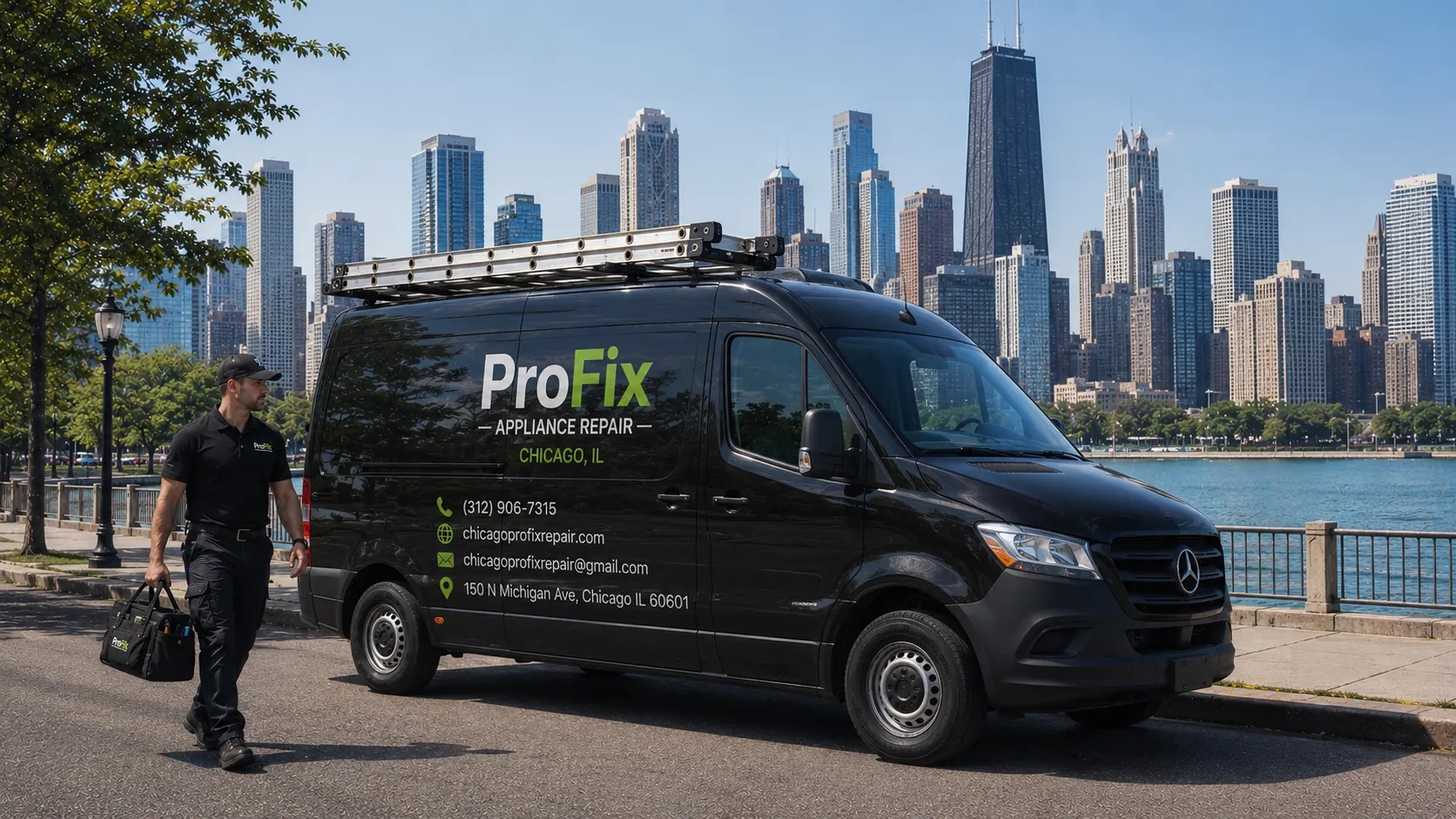
ProFix Appliance Repair Chicago is Park Ridge & Des Plaines's trusted source for local Speed Queen appliance repair. Our neighborhood technicians are specifically trained on Speed Queen models and carry genuine OEM replacement parts, so most Park Ridge & Des Plaines Speed Queen repairs are diagnosed and fixed in a single visit — backed by a 90-day parts and 30-day labor warranty.
How It Works
Related Services
Available Now · Chicago, IL
Ready to schedule your repair?
ProFix Appliance Repair Chicago — trusted by thousands of Chicago homeowners. Same-day slots available.
Speed Queen Appliance Repair in Park Ridge & Des Plaines — Common Questions
Can't find your answer? Book a service call or call us now.
Still have questions?
Our Chicago team is ready — same-day service across Cook County.