

GE Certified — Crystal Lake, Cary & Fox River Grove
GE Repair Near Me in Crystal Lake, Cary & Fox River Grove, McHenry County, IL
Local GE appliance repair near you in Crystal Lake, Cary & Fox River Grove — certified neighborhood technicians, genuine OEM parts, same-day availability across McHenry County.
Mon–Sat 7am–8pm · Sun 9am–5pm
Schedule Your Repair
Service Type
What type of service do you need?
Or call us directly:
(312) 906-7315GE Appliances We Repair in Crystal Lake, Cary & Fox River Grove
GE Refrigerator
Repair in Crystal Lake, Cary & Fox River Grove →
GE Washer
Repair in Crystal Lake, Cary & Fox River Grove →
GE Dryer
Repair in Crystal Lake, Cary & Fox River Grove →
GE Dishwasher
Repair in Crystal Lake, Cary & Fox River Grove →
GE Oven / Range
Repair in Crystal Lake, Cary & Fox River Grove →
GE Microwave
Repair in Crystal Lake, Cary & Fox River Grove →
GE Freezer
Repair in Crystal Lake, Cary & Fox River Grove →
GE Cooktop
Repair in Crystal Lake, Cary & Fox River Grove →
GE Wine Cooler
Repair in Crystal Lake, Cary & Fox River Grove →
GE Stove
Repair in Crystal Lake, Cary & Fox River Grove →
GE Range
Repair in Crystal Lake, Cary & Fox River Grove →
How GE builds appliances, and why it matters
The GE line dates to 1907 and grew out of United States, which still shapes how the equipment is put together; commercially it occupies the mainstream tier. What actually matters to a repair is the engineering commitment to broad model range from builder-grade to Cafe and Profile premium lines. That single decision sets the load path through the machine, and the load path sets the failure list — which is why a GE fault list is not interchangeable with any other brand's. For owners in Cook County it also sets the economics, since the gap between long-held bungalow appliances and near-new condo installs is unusually wide, so two machines of the same model year arrive in very different condition.
Servicing GE well comes down to one piece of brand knowledge — GE's builder-grade lines and its Cafe/Profile lines are engineered very differently despite the shared badge. Without it a technician will condemn the wrong component often enough that the customer ends up funding the learning curve. That is a worse trade in Chicago than in most markets, because parts move through Chicago-area distribution with same-day will-call on common stock.
In practice that means we approach GE equipment with a specific order of checks rather than a generic one. Building around broad model range from builder-grade to Cafe and Profile premium lines changes what a noise, a temperature drift or an intermittent electrical fault most likely indicates, and starting from the brand's actual architecture is faster and cheaper than starting from the symptom alone. In Chicago we add one more input before touching anything: two-flat and bungalow panels were sized before dishwashers and induction cooking, and condo towers add house-panel limits an individual owner cannot do anything about.
What Chicago conditions do to GE appliances
No two markets treat a GE the same way, and Chicago has its own signature. What dominates here is brutal winters and wide seasonal temperature swings, with unheated garages and basement laundry rooms swinging across a 100°F annual range. Service intervals published for GE assume an average environment that Chicago simply is not, with the result that domestic machines installed here wear on a timetable the manual never anticipated.
Climate is only half of it; for GE the building matters just as much. Cook County is a mix of pre-war brick two-flats and bungalows alongside high-rise condo stock, where freight-elevator scheduling and tight galley kitchens shape every visit, and that is the setting every GE here has to work in. It bears directly on refrigerator control boards, dishwasher circulation pumps, and igniters on gas ranges, because how the machine was fitted governs both how fast that fault develops and whether it can be put right without pulling the appliance out.
Then there is water, which most owners never think about until something scales up. Chicago runs Lake Michigan supply in the city and mineral-heavy well sources across parts of the suburbs, delivered untreated to GE fill valves, spray arms and any water-fed part. The freeze–thaw cycle stresses water lines and ice makers hardest between December and March, and high-rise pressure swings add a second variable the suburbs do not have. A GE follows the same seasonal pattern.
The GE faults that bring us out
The GE faults we see repeatedly across Cook County cluster tightly: refrigerator control boards, dishwasher circulation pumps, and igniters on gas ranges. None of that is a generic appliance profile — it is specific to how GE builds — and arriving with it in mind is most of the diagnostic work already done.
GE refrigerator, washer, dryer, dishwasher, oven are all within scope, along with the rest of the line. The diagnostic routes barely overlap between categories even inside a single brand, which is why we do not run one generic checklist across them. In Cook County the balance of what comes in tracks the housing stock closely, because the gap between long-held bungalow appliances and near-new condo installs is unusually wide, so two machines of the same model year arrive in very different condition.
On GE we treat "the electronics have failed" as a hypothesis rather than a conclusion. Drain height, vent length, ventilation clearance and circuit capacity all produce faults that look electronic, and all four are cheaper to correct than the board they would otherwise condemn. In Chicago housing a fifth belongs on the list, because freight-elevator windows and reserved loading docks decide when a high-rise job can actually happen, and a missed window costs a day rather than an hour.
Chicago's conditions add their own layer to GE service. Where the local stressor is brutal winters and wide seasonal temperature swings, GE components exposed to it age faster than the design assumption, and a fault that would appear at year eight elsewhere can appear at year five here.
Discontinued lines and the parts-availability question
Some of what we service is no longer manufactured, surviving as an installed base in homes and rental properties. These machines are frequently mechanically sound — simpler, heavier and more repairable than their modern equivalents — and the limiting factor on repair is almost never skill or economics. It is whether the part still exists.
So we check availability before quoting rather than after. A confident diagnosis that cannot be acted on wastes the customer's money and their time, and on discontinued lines that is a real risk rather than a theoretical one.
Where a component is genuinely unavailable we say so plainly and price the repair against replacement rather than fitting a marginal substitute that will fail differently in six months. Occasionally a compatible part from a sibling brand or a later platform fits, and where it does and is genuinely equivalent we use it and tell you that is what we have done.
GE parts, warranty and lead times
Whether a GE repair is worth doing often turns on supply rather than on the fault: strong nationwide network; older Hotpoint-era parts get scarce. So we check what is actually obtainable before putting a number on the job — quoting first and discovering the lead time afterwards helps nobody, and on mainstream machines that gap runs from same-day to several weeks. In Cook County the relevant detail is that parts move through Chicago-area distribution with same-day will-call on common stock; we price against your model number, not the badge.
Every GE repair we complete is warranted 90 days on parts and 30 on labour across all of Cook County. We also check manufacturer coverage before quoting — GE equipment inside its original warranty should go through that channel, and we would rather lose the job than void it.
Where a GE component is genuinely discontinued, we say so directly and price the repair honestly against replacement rather than fitting a marginal substitute that will fail differently in six months. That conversation happens more often on some brands than others, and on GE the deciding factor is usually availability rather than cost. In Chicago it is also worth weighing that the gap between long-held bungalow appliances and near-new condo installs is unusually wide, so two machines of the same model year arrive in very different condition.
Our GE coverage takes in Lakeview, Evanston, Oak Park and Schaumburg along with the rest of Cook County. Morning bookings generally get a same-day slot, and no part of the county carries a travel surcharge.
What extends GE service life in Cook County
Nearly everything that cuts a GE's life short in Cook County could have been avoided, and almost none of it appears in the owner's manual — which was written for average conditions, not for brutal winters and wide seasonal temperature swings. If you do only one thing to a GE, keep the condenser and heat-exchange surfaces clean. Airflow restriction forces the compressor or element into continuous overwork, and continuous overwork is precisely what converts a ten-year machine into a six-year one.
The second factor for GE is water. With Lake Michigan supply in the city and mineral-heavy well sources across parts of the suburbs reaching every water-fed GE component untreated, inlet screens, spray arms and fill valves scale gradually rather than failing suddenly. On GE that shows up first as declining performance that owners adapt to without noticing — longer cycles, poorer cleaning, slower ice production — and by the time it is reported the deposit has usually been building for years. On GE equipment, descaling on a schedule costs a fraction of the repair it prevents.
Third is the installation, which for GE in Cook County housing is a genuine failure driver rather than a formality. A mix of pre-war brick two-flats and bungalows alongside high-rise condo stock, where freight-elevator scheduling and tight galley kitchens shape every visit means clearances, drain heights and vent runs are frequently outside specification from the day the appliance went in. Those do not announce themselves; on GE they present years later as component failures, and correcting the installation resolves what replacing the part does not.
The one recommendation worth acting on for GE owners in Chicago: get the brand's known weak points — starting with refrigerator control boards, dishwasher circulation pumps, and igniters on gas ranges — looked at on your schedule rather than the machine's. A planned inspection on mainstream equipment is a fraction of what the emergency visit costs, and the difference is wider here than elsewhere because freight-elevator windows and reserved loading docks decide when a high-rise job can actually happen, and a missed window costs a day rather than an hour.
GE in Crystal Lake, Cary & Fox River Grove — Service Snapshot
Based on ProFix GE service calls across Cook County over the last 12 months.
Other Brands We Service in Crystal Lake, Cary & Fox River Grove















































Built for Chicago — Homes, Condos & More
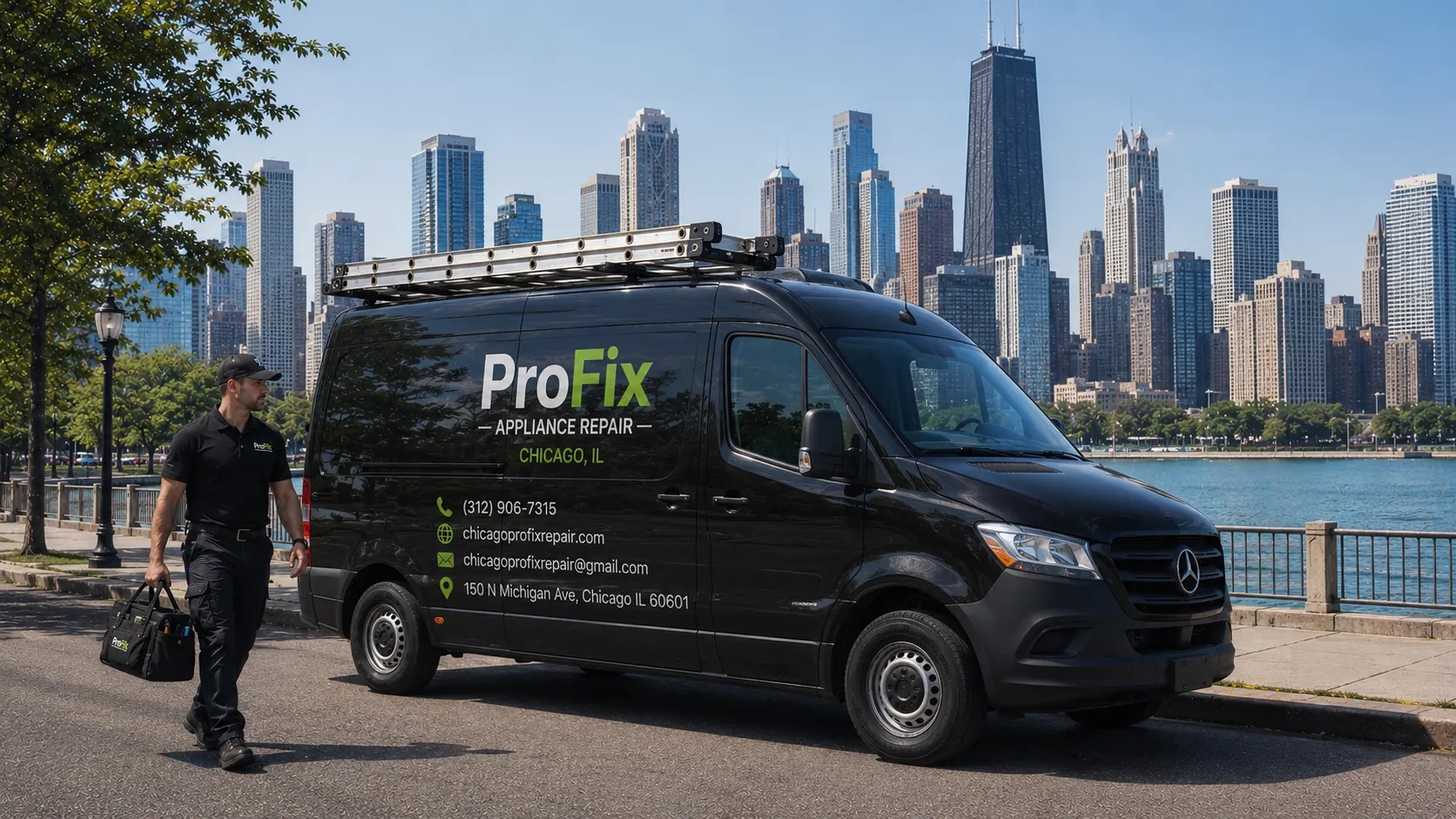
ProFix Appliance Repair Chicago is Crystal Lake, Cary & Fox River Grove's trusted source for local GE appliance repair. Our neighborhood technicians are specifically trained on GE models and carry genuine OEM replacement parts, so most Crystal Lake, Cary & Fox River Grove GE repairs are diagnosed and fixed in a single visit — backed by a 90-day parts and 30-day labor warranty.
How It Works
Available Now · Chicago, IL
Ready to schedule your repair?
ProFix Appliance Repair Chicago — trusted by thousands of Chicago homeowners. Same-day slots available.
GE Appliance Repair in Crystal Lake, Cary & Fox River Grove — Common Questions
Can't find your answer? Book a service call or call us now.
Still have questions?
Our Chicago team is ready — same-day service across Cook County.